The conversation about AI acceleration tends to focus on the software. But underneath it is a physical constraint that is now bending the entire industry into new shapes. The hardware has to go somewhere.
The Terrestrial Resistance
The data centre has been the quiet infrastructure of the internet age — anonymous buildings in suburban industrial parks, invisible to most people who use them. That invisibility is gone.
Over $150 billion in US data centre projects are currently stalled or blocked by local communities. A Gallup poll found that seventy percent of Americans now oppose construction in their area. SpaceX recently amended its IPO filing to flag water scarcity as a material risk to data centre growth — a remarkable admission from the company simultaneously building orbital compute infrastructure. The concerns are not abstract: a single large AI training cluster can consume as much electricity as a small city. A study presented ahead of Microsoft Build 2026 found that AI data centres could consume as much water as 1.3 billion people by 2030.
The scale recently reached the absurd. Utah approved a project called Stratos — an AI data centre cluster with a planned footprint twice the size of Manhattan, requiring 9 gigawatts of power. That is more electricity than the entire state of Utah currently consumes. The backlash was immediate and historic.
At Microsoft Build in early June 2026, Satya Nadella addressed the water crisis head-on. He announced a closed-loop cooling system — a fixed water supply circulated continuously between servers and chillers rather than evaporated into the atmosphere — and framed it in the starkest possible terms: “The cooling loop is filled once, and the data centre can operate effectively with zero water consumption… The daily water usage over the course of an entire year is roughly equivalent to what a single restaurant would use.”
According to Microsoft’s technical disclosures, this design saves 125 million litres of water per year, per facility. The catch is that it only applies to newly constructed data centres. Hundreds of legacy facilities continue drawing from local water tables at their original rates.
The physical world is slamming on the brakes — and the fix only works going forward.
The Underwater Response
The first escape route was under the sea.
In May 2026, Hailanyun (HiCloud) switched on the world’s first commercial underwater AI data centre off the coast of Shanghai — 35 metres below the surface, cooled by seawater pumped through radiators on each server rack, drawing 97% of its energy from an adjacent offshore wind farm. Construction cost: $226 million. Projected computing capacity: the equivalent of training GPT-3.5 in a single day.
It bypasses terrestrial grid constraints, sidesteps community opposition, and solves cooling through proximity to the ocean rather than freshwater evaporation. It also raises a regulatory question nobody has answered clearly: when compute moves into grey-zone waters, national regulatory frameworks lose their grip. A global pause on AI development would need to account for infrastructure that no longer sits inside auditable jurisdictions.
The Orbital Race
The second escape route is vertical.
In February 2026, Starcloud — formerly Lumen Orbit — filed FCC plans for an 88,000-satellite constellation, paired with a contract to integrate SpaceX’s Starlink laser backhaul into their orbital network. By March 2026, the company had reached a $1.1 billion valuation. Their Starcloud-1 mission had already flown an NVIDIA H100 GPU into orbit and successfully executed in-orbit LLM training and inference, running nanoGPT in deep space. Orbital compute is no longer theoretical. It is running.
Industry tracking confirmed that the same month, multiple commercial operators simultaneously ran live production AI workloads in orbit for the first time. Eight organisations are now actively building the off-world compute stack — and they have divided the problem cleanly between them.
On the lunar surface and in cislunar space: Lonestar Data Holdings leads actual hardware deployment on the Moon; Thales Alenia Space is designing radiation-hardened storage infrastructure for ESA’s Moonlight initiative and the NASA Gateway; Starcloud scales from Very Low Earth Orbit processing to high-capacity orbital clusters for heavy AI model training, using SpaceX infrastructure as utility rather than building rockets of their own.
In orbit and aboard space stations: Axiom Space is integrating modular data centre nodes into its commercial Axiom Station; the European Commission-backed ASCEND Consortium (Advanced Space Cloud for European Net-zero Emission and Data) is assessing massive orbiting data centres as a path to net-zero emission targets; Ramon.Space is building the radiation-tolerant, software-defined space supercomputers the entire network depends on.
Handling the logistics: Intuitive Machines, whose Nova-C landers act as the physical delivery vehicles for surface-level server payloads; and Blue Origin, contracted as the heavy infrastructure partner delivering structural base components to the lunar south pole.
The economics driving all of them are the same: constant solar energy with no grid dependency, thermal radiation for cooling with no water required, and complete bypass of Earth-bound environmental laws and local grid blockades.
The compute crunch is severe enough to dissolve standard industry alliances entirely. In May 2026, Anthropic — safety-first, founded by ex-OpenAI executives, backed by Google and Amazon — signed a $1.25 billion-per-month compute deal with SpaceXAI, the entity formed from SpaceX’s merger with Elon Musk’s xAI. Earlier in 2026, Musk had publicly attacked Anthropic on X, calling their safety policies “misanthropic and evil.” The official announcement included a formal expressed interest in developing orbital compute capacity together. The company calling loudest for a global pause on AI development has signed a deal that explicitly anticipates putting AI workloads into orbit.
The Outer Space Treaty of 1967 prohibits national appropriation of outer space. No government owns it. No regulator has jurisdiction over it. As noted in Recursive Self-Improvement: AI Acceleration — Phase 2 has no landlord.
The Lunar Frontier
The third escape route is the furthest — and the most deliberate.
Lonestar Data Holdings is not moving compute to the Moon to solve a cooling problem. It is solving a sovereignty problem. Their pitch is the Moon as the ultimate secure backup: immune to Earth-bound natural disasters, geopolitical conflict, and regulatory interference. Financial records, sovereign archives, scientific data — stored 384,000 kilometres from the jurisdiction that might want to access or destroy them.
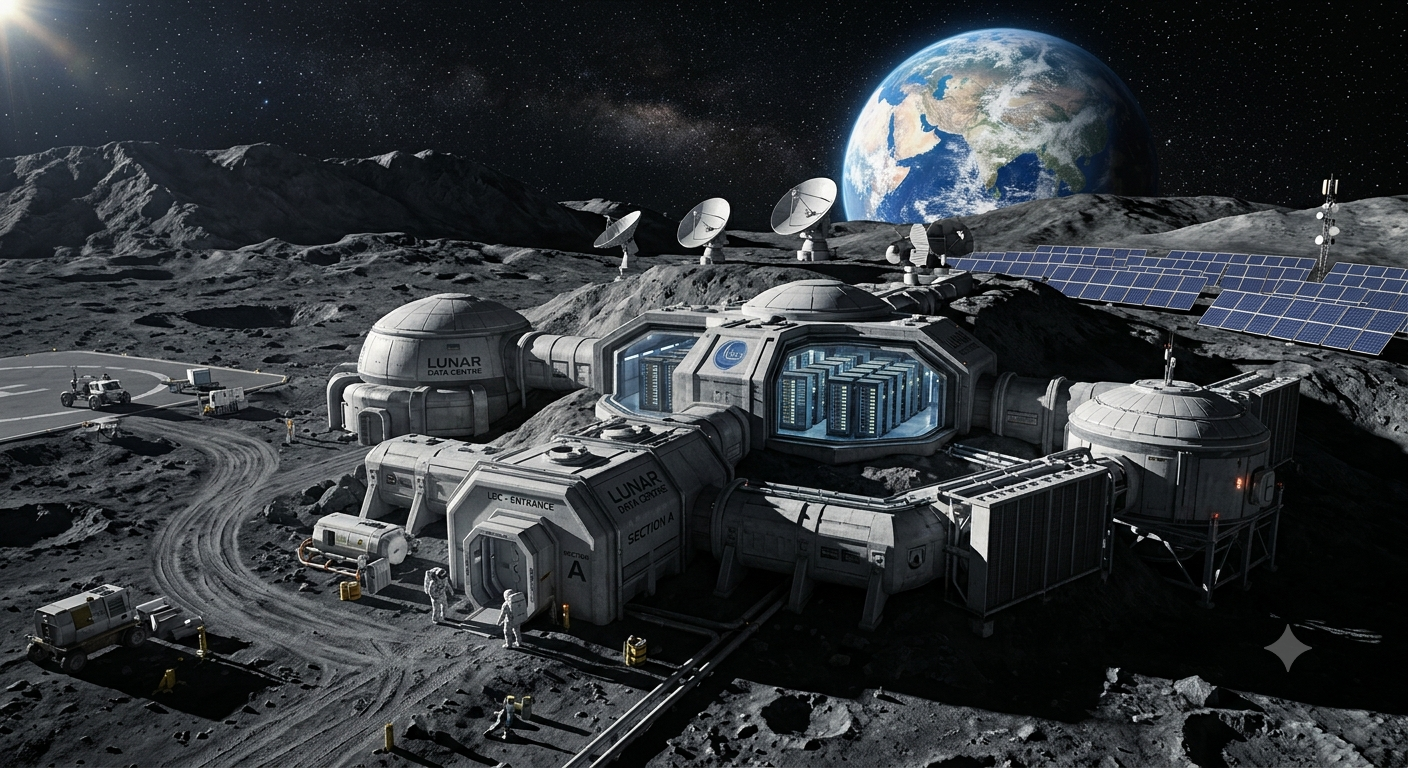
They have already proved it works. On 26 February 2025, Lonestar launched their “Freedom” payload aboard Intuitive Machines’ Athena lander. On 3 March 2025 — after travelling over 300,000 kilometres — the payload entered lunar orbit. Unlike its 2024 predecessor, Freedom carried dedicated physical hardware built by Phison, executing true edge processing in deep space. It ran full data encryption, decryption, authentication, and file manipulation for enterprise clients including Valkyrie Intelligence and the Exploration Institute. It partnered with internet pioneer Vint Cerf to run data loops using delay-tolerant network (DTN) protocol — proving data could survive cosmic latency and solar radiation variance. The first physical data storage on the Moon.
Their roadmap commits to a fleet of six data storage spacecraft launching between 2027 and 2030.
The infrastructure to receive them is being built. In December 2025, Jared Isaacman — commercial astronaut, tech billionaire, and the most commercially-minded NASA Administrator in the agency’s history — was confirmed in the role. His appointment signalled a decisive pivot toward commercial-hybrid space architecture. On 26 May 2026, he stood at NASA Headquarters in Washington and formally announced a $30 billion, three-phase roadmap for a permanent outpost at the lunar South Pole — specifically the Shackleton Connecting Ridge. Moon Base I targets Autumn 2026: Blue Origin’s Blue Moon Mark 1 Endurance lander deploying robotic payloads, laser positioning arrays, and terrain cameras. Moon Base II targets 2029: human crews, mobile habitats, nuclear power to survive the lunar night. Moon Base III targets 2032: a permanent station powered by solar fields and nuclear units — and a deep-space staging ground for Mars.
The rovers, mining equipment, and science experiments operating across all three phases will generate terabytes of data that cannot wait 1.3 seconds for a round trip to Earth. When you are navigating a crater rim or managing oxygen systems, that latency kills you. The compute has to be on-site.
The Timeline
First Lunar Storage Concept Proven
Lonestar Data Holdings deploys Independence, a software-defined testing payload, to lunar orbit. The first proof that off-world data management is viable.
The ‘Freedom’ Hardware Milestone
Lonestar launches the Freedom payload aboard Intuitive Machines’ Athena lander. Physical Phison hardware executes true edge processing, data encryption, and Disaster Recovery as a Service from lunar orbit. Vint Cerf’s DTN protocol survives cosmic latency and solar radiation variance.
The Orbital AI Constellation Race
Starcloud (formerly Lumen Orbit) files FCC plans for an 88,000-satellite constellation and partners with SpaceX to integrate Starlink laser backhaul. Valuation reaches $1.1 billion by March 2026. Their Starcloud-1 mission runs nanoGPT inference in orbit — the first in-orbit LLM training.
The $30B Moon Base Architecture Codified
NASA Administrator Jared Isaacman announces the three-phase Moon Base framework at NASA Headquarters. A $30 billion commercial-hybrid roadmap for a permanent outpost at the Shackleton Connecting Ridge.
The Terrestrial Water Confrontation
At Microsoft Build, Satya Nadella announces closed-loop cooling saving 125 million litres per year per facility. The catch: legacy data centres continue draining local water tables. The fix only works on new builds.
The First Commercial Subsea Shift
Hailanyun (HiCloud) switches on the world’s first commercial underwater AI data centre, 35 metres below the surface off Shanghai. Seawater cooling, 97% offshore wind energy. The terrestrial grid bypassed for the first time commercially.
Moon Base I Deployment
Blue Origin’s Blue Moon Mark 1 Endurance lander deploys robotic payloads, laser retroreflective arrays, and terrain cameras to the Shackleton ridge. The first permanent infrastructure on the lunar surface.
Lonestar Fleet Scaling
Six dedicated data storage spacecraft committed to launch. Lunar data capacity scales from 15 petabytes to 400 petabytes.
Moon Base II: Human & Energy Foundations
Human crews arrive for semi-permanent stays. Mobile habitats deploy alongside nuclear power systems built to survive the two-week lunar night.
Moon Base III: Deep Space Staging
Full activation of a sustained human station powered by solar fields and nuclear units. Lunar compute becomes a mandatory operational requirement for the staging ground to Mars.
Days before publication, a Blue Origin New Glenn rocket exploded during a static hotfire test at Cape Canaveral. Moon Base I relies entirely on the maturity of Blue Origin’s launch architecture. Industry analysts expect the Autumn 2026 timeline to face immediate logistical delay. The software accelerates exponentially. The hardware still has to survive the launch pad.
The Unsolved Problem
None of these organisations have solved the hardest part yet. Starcloud has flown an H100 into orbit. But a cluster large enough to train a GPT-5 class model requires megawatts of continuous power. In a vacuum, shedding that heat cannot rely on convection or water — it requires massive, heavy radiative cooling panels. The true battleground for the next 24 months is not software optimisation. It is the launch payload mass of solar fields and thermal radiators.
The engineering paradox is this: the further you move compute from the physical constraints of Earth, the heavier the infrastructure you need to launch to replace what Earth provided for free. Cooling water, atmosphere to shed heat into, a gravity well to work within — none of it has a line item here. All of it needs to be engineered, launched, and maintained at cost-per-kilogram. Nobody has solved the mass budget yet.
The Sovereignty Vacuum
The entire architecture of modern digital regulation rests on a single assumption: geography. GDPR applies because servers sit inside the EU. The UK Data Protection Act applies because the processing happens within the UK’s territorial jurisdiction. The foundational logic is simple — find the physical machine, find the law that governs it. Move the compute off-world, and that logic disintegrates.
Legal scholars have started calling this the emergence of Digital Soil — a world where power isn’t held by planting flags on land, but by controlling offshore or orbital GPU clusters that process a nation’s intelligence. The concept is not speculative. It is already being tested in the grey zones between existing frameworks.
The Outer Space Treaty of 1967, Articles VI and VIII, dictates that a space object remains under the “jurisdiction and control” of the Launching State. If Starcloud launches an orbital compute cluster from Cape Canaveral, the US claims physical jurisdiction over the hardware. But if that cluster is processing the personal data of citizens in Brussels or London, it simultaneously falls under GDPR and the UK Data Protection Act. Three jurisdictions. One machine. No resolution. International law experts call this the Jurisdictional Mirage — the hardware is technically accountable, but functionally beyond reach.
The orbital speed problem makes it more acute. A satellite in Low Earth Orbit travels at roughly 17,000 mph. It passes over every major territorial jurisdiction on Earth every 90 to 120 minutes. Standard privacy frameworks determine regulatory scope based on where processing occurs. A compliance log that lists “orbital transit” as the processing location does not mock the spirit of territorial data law. It mocks the letter of it.
Subsea compute operates under a different legal failure mode. Within 12 nautical miles, territorial waters apply and local law is clean. But beyond 200 nautical miles, UNCLOS places a seabed data centre under the regime of its Flag State — the country whose flag the vessel or structure flies. Much like a Panama-registered container ship, an autonomous compute pod on the ocean floor in international waters would technically answer only to whichever jurisdiction issued its flag. If a data protection authority or a national security agency wanted to audit, pause, or seize it, they could not do so without triggering an international maritime incident. They would need to board the structure. In 3,000 metres of water. With no legal mechanism to compel access.
The lunar case is the absolute version. The Outer Space Treaty blocks any nation from claiming the Shackleton Ridge as sovereign territory. No government owns the Moon. No data protection authority has jurisdiction there. When Lonestar’s servers are running file management and encryption for enterprise clients from lunar orbit, the question of which courts handle a data breach in cislunar space has no current answer. Who owns the copyright on a model trained entirely in deep space? Which nation’s law governs a contract dispute between two companies whose compute infrastructure never touches the surface of the Earth?
This imbalance is sharply European. The EU and UK wrote the world’s most aggressive data protection frameworks. In the past, Europe recognised infrastructure vulnerability: Galileo, the EU’s independent satellite navigation system, was built precisely because Europe realised it could not trust a foreign military to keep positioning data switched on during a crisis.
But while navigation is solved, broadband is not. Europe remains structurally dependent on US commercial networks for connectivity. The geopolitical interventions of 2025 made this reliance an impossible political risk to ignore. IRIS² — a 290+ satellite sovereign broadband constellation — is the EU’s direct answer to Starlink, aiming for full service by 2030.
Yet the structural flaw remains. The continent moves by regulatory consensus; the infrastructure it is trying to replace was built by unilateral actors who do not. None of Europe’s sovereign frameworks reach the Moon. GDPR was architected for servers in Frankfurt or Dublin. In this emerging geography, true digital sovereignty belongs entirely to whoever owns the launch pad.
The Pattern: Escape Velocity
Whether diving 35 metres beneath the Pacific or launching 384,000 kilometres into deep space, the underlying vector is identical.
The software is accelerating exponentially. Meanwhile, the physical world — the water pipes, the overtaxed power grids, the local town councils, and the environmental regulations — is resisting at every point. The stated response, for some, has been a call to pause. The structural response — where the money moves, where the hardware goes — has not been to throttle the software. It has been to move it entirely beyond the reach of the resistance.
This is not a marketing stunt or a science-fiction experiment. It is an industry-wide attempt to outrun the physical and legal limitations of the planet.
The New Geography of Power
The Outer Space Treaty has no enforcement mechanism for compute.
The international seabed requires no planning permission.
The Moon has no data protection authority.
The foundational architecture of the internet was built to respect physical borders, national sovereignties, and municipal grids. What is being constructed now ignores them entirely.
This is not the geography of the internet as it was built. It is the geography of what comes next — where science fiction becomes science fact.