At Google I/O 2026, the tech giant dropped a significant anchor into the AI transparency debate. Google announced native C2PA Content Credentials across Google Search, Chrome, and the Gemini app, alongside a major scaling of its SynthID watermarking toolkit. Every major tech publication ran the headline: Google joins the fight against deepfakes.
This post isn’t about the announcement. It’s about the fundamental paradox the announcement exposes.

The Content Credentials mark, designed to act as a digital nutrition label for media. Source: C2PA
The Nutrition Label for the Internet
The Coalition for Content Provenance and Authenticity (C2PA) — backed by Adobe, Microsoft, Sony, Leica, and now Google — was built to solve an explicitly human problem: how do I know this photograph hasn’t been doctored?
It works by embedding cryptographically signed metadata directly into a file. A digital chain of custody:
- Capture — A photo is taken on a C2PA-compliant camera, instantly signing the timestamp and sensor data.
- Edit — The image is imported into software like Adobe Photoshop, which records any alterations as additional “ingredients” in the history manifest.
- Verification — The publisher distributes the file; end users can inspect its history via tools like contentcredentials.org or Google’s new inline browser systems.
This works brilliantly for traditional disinformation. If someone alters a photo of a politician, the cryptographic binding breaks or lists the manipulation explicitly. It tells you exactly how media travelled from a camera lens to your screen.
The Core Shift: Media Without an Origin
The glaring flaw is that C2PA was architecturalised for a world where media starts with an origin — a singular, physical moment in time captured by glass and a sensor. But the content landscape has shifted fundamentally underneath it.
What happens when media has no origin?

World Labs: an entire navigable 3D environment generated from a single reference image.
Consider platforms like World Labs, Apple’s ml-sharp optimisations, or Hyperscapes. When an entire, navigable 3D world is generated from a single prompt or a solitary reference image, what exactly are we signing? Or take the case of a Gaussian splat — a volumetric, neural reconstruction of a physical space assembled by an algorithm parsing public Flickr data.
If a creator processes thousands of individual, uncredited Flickr photos to render a flawless 3D environment, who is the author?
- Is it the hundreds of random holiday photographers whose shots were scraped?
- Is it the neural network interpreting the data points?
- Is it the platform hosting the render?
As the underlying training data lacks provenance tracking, the final credential doesn’t sign an origin. It signs a mathematical process. We aren’t verifying where a piece of content came from; we are merely certifying the synthetic pipeline that extruded it.
The Production Pipeline and the Two-Tier Reality
In professional production circles, C2PA is scaling up rapidly. Enterprise creative applications and non-linear editors are embedding these credentials directly into high-end broadcast and post-production workflows. As a result, we are seeing a distinct split in how media is produced:
| Credentialed Capture | Uncredentialed Generation | |
|---|---|---|
| Workflow | Volumetric rigs and high-end studio cameras recording real-world actors with cryptographically locked provenance. | AI-native generators extruding entire virtual sets, backgrounds, and voiceovers dynamically from prompt architectures. |
| Trust Profile | High corporate accountability; legally defensive; tamper-evident manifests. | Highly fluid; untraceable training data lineages; functionally dynamic. |
| Ecosystem | Traditional newsrooms, premium live broadcasts, institutional media. | Social commerce, indie gaming, hyper-personalised entertainment. |
This split points to an emerging, starkly divided two-tier content world. On one hand, you have high-trust, heavily verified physical captures that are expensive to make and legally ironclad. On the other, a wild west of infinitely scalable, synthetic generation where individual attribution is entirely erased from the equation.
The Subconscious Scrape
This highlights a much deeper challenge to Jaron Lanier’s concept of Data Dignity. Current synthetic models have already scraped the open web to mimic human creativity, bypassing any provenance tracking for the original creators. As we look toward the horizon of Brain-Computer Interfaces (BCIs), this boundary shifts from public portfolios to our inner lives, where neuro-generative systems could soon translate subconscious neural impulses directly into media.

Vitruvian Person — sculptures shaped by EEG brainwave data. Artist: Samuel Stubblefield. Via g.tec, 2025.
C2PA is structurally unequipped for this reality because it cannot go upstream into a model’s training data. The credential signs the final output — verifying which software generated the file at what time — but it remains completely silent on the input layer.
When a model generates an asset, it does so because it has absorbed the visual language, styles, and techniques of millions of artists. C2PA only validates the final cryptographic execution of the code, leaving the creative debt owed to those original human sources entirely invisible.
Necessary, But Insufficient
Google’s sweeping I/O 2026 announcement should be welcomed. Implementing C2PA and SynthID into consumer browsers is a vital piece of digital infrastructure. It turns verification from a niche forensic activity into a default public utility.
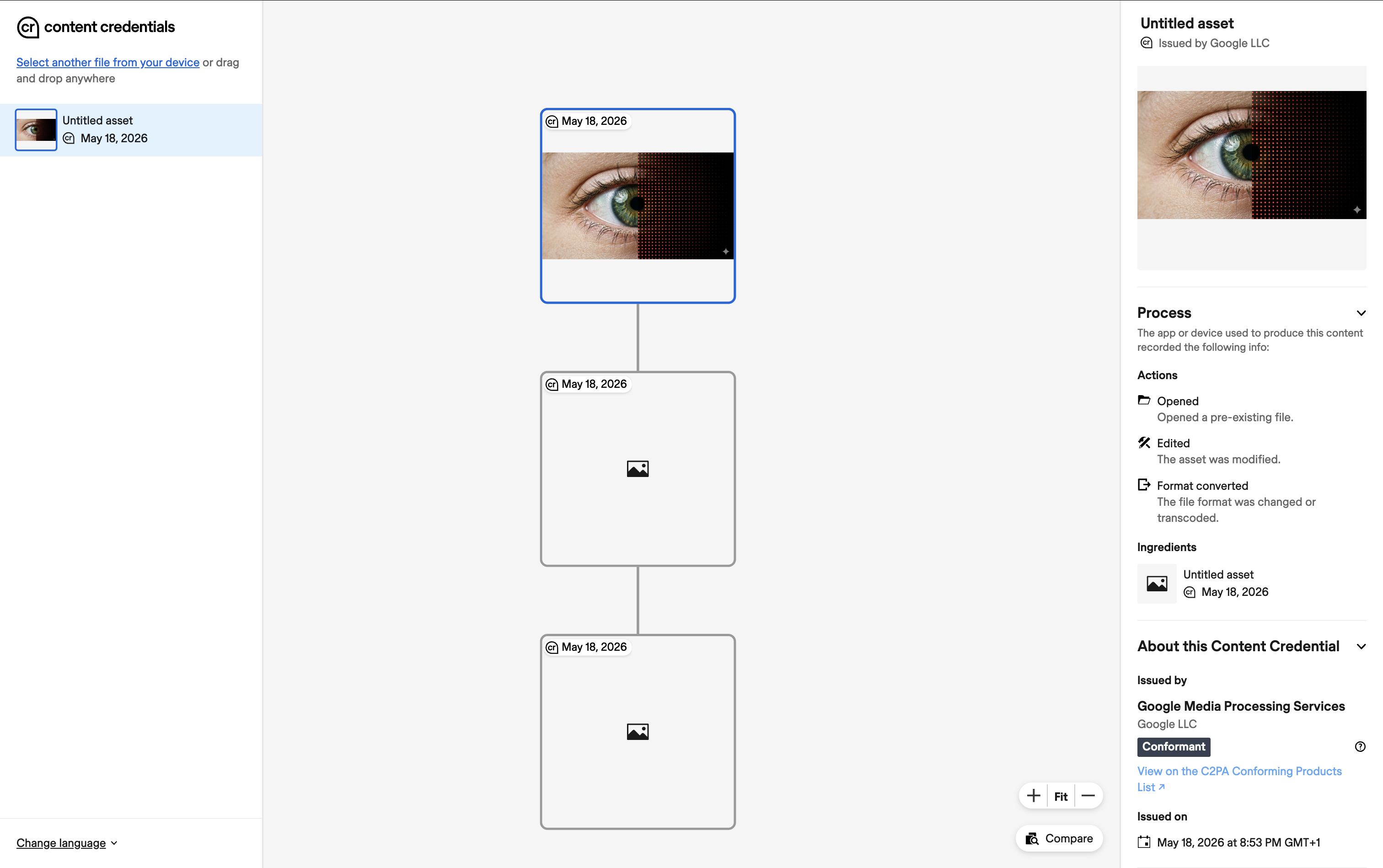
A verified content credential issued by Google Media Processing Services, May 2026.
The limitation is clear: a content credential can tell you exactly how a piece of media was assembled. It cannot trace what the model learned, or from whom.
As we move into an era dominated by synthetic workflows and neural reconstructions, signing the output is a defensive half-measure. Until we solve the provenance problem at the input layer — the data layer where models learn to mimic human expression — our content credentials will remain beautifully signed labels on entirely empty packages.