From “Proving Ground” to the foundations of coding.
History has a peculiar way of remembering the hardware and forgetting the hands that made it hum. For decades, the story of the ENIAC—the world's first general-purpose, all-electronic computer—was told through the lens of the engineers who built the vacuum tubes and circuits. But as Kathy Kleiman reveals in Proving Ground, the machine was a silent monolith until six women taught it how to think.
The story of the “ENIAC Six” is not just a footnote; it is the origin story of software itself. To understand their impact, we must look at how women have been the backbone of computing from the era of hand-calculations to the birth of the modern compiler.
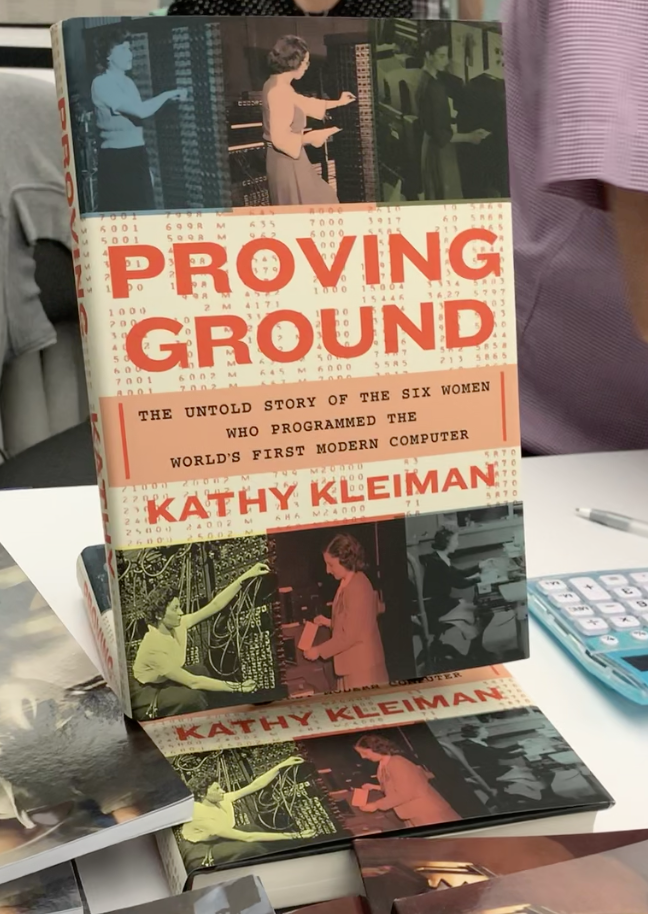
Proving Ground — Kathy Kleiman · SIGGRAPH 2023, Los Angeles
The ENIAC Six: Programming Without a Language
In 1945, the U.S. Army unveiled the ENIAC, a 30-ton behemoth designed to calculate ballistics trajectories. While the men were credited with the hardware, six brilliant mathematicians—Kay McNulty, Betty Holberton, Jean Bartik, Marlyn Wescoff, Ruth Lichterman, and Frances Bilas—were tasked with the “clerical” job of making it work.
There were no manuals, no C++, and no Java. These women had to study logical blueprints, crawl through the machine to flip thousands of switches, and manually plug in patch cables. They essentially invented the concepts of subroutines and nested loops by understanding the physical architecture of the machine. When the ENIAC was finally demonstrated to the public, the women were there—but they were often cropped out of the photographs or dismissed as “refrigerator ladies” posing with the kit.
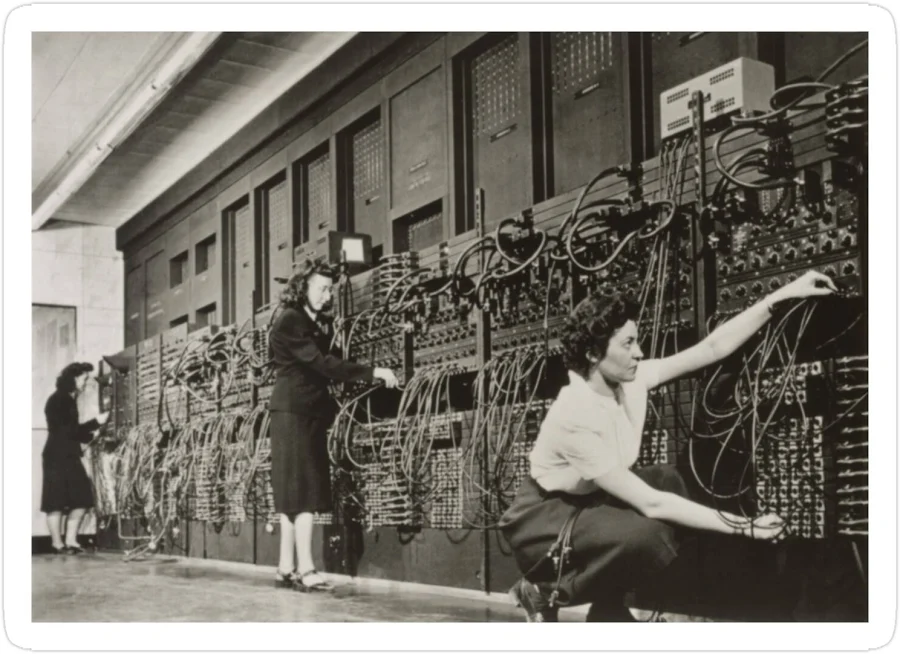
Women working on the ENIAC · 1946
The Human “Computers”
The term “computer” didn't always refer to a silicon chip. For centuries, it was a job title, often held by women.
- The Harvard Computers In the late 19th century, Edward Charles Pickering hired a team of women to process astronomical data. Figures like Annie Jump Cannon classified hundreds of thousands of stars, creating the system we still use today.
- Bletchley Park During the Second World War, thousands of women worked as Colossus operators and codebreakers. Their mathematical precision was the engine behind the cracking of the Enigma code.
- NASA's Hidden Figures As seen in the story of Katherine Johnson, women were the “human computers” who calculated the orbital trajectories for the first Americans in space. Their work was so trusted that astronaut John Glenn famously refused to fly until Johnson personally “checked the numbers” generated by the new electronic machines.
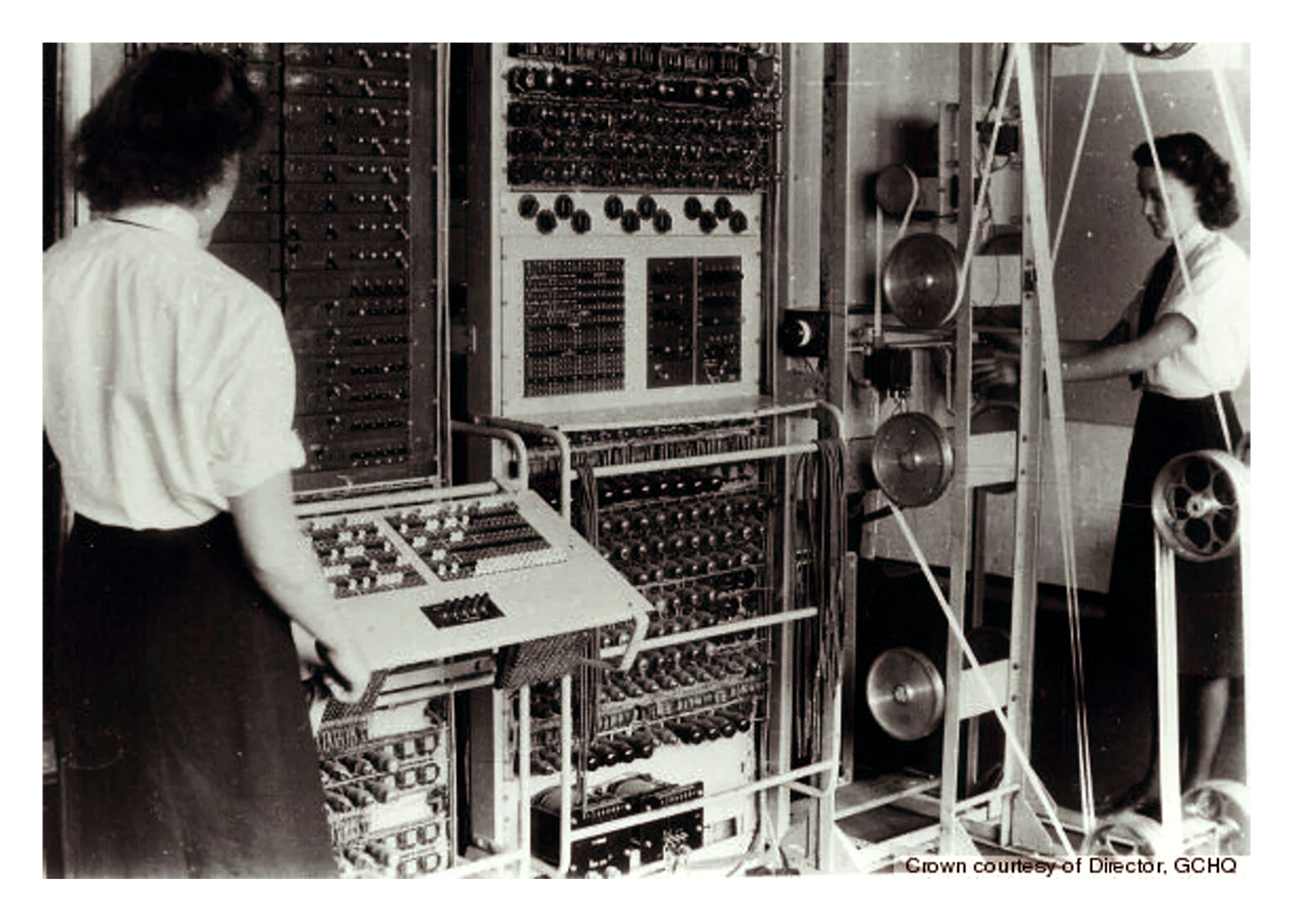
Women at Bletchley Park · WWII
From Calculations to Logic: Grace Hopper
If the ENIAC Six invented the practice of programming, Grace Hopper invented the way we talk to computers. A Rear Admiral in the U.S. Navy, Hopper believed that computer code should be readable by humans, not just machines.
She developed the first compiler (A-0), which translated mathematical code into machine language. This eventually led to the creation of COBOL, one of the first high-level programming languages that used English-like commands. Hopper's vision democratised computing, moving it out of the hands of hardware specialists and into the realm of business and logic.
Breaking the Binary
The history of computing is often framed as a series of hardware breakthroughs, but the “logic” of the digital age was largely forged by women who saw the potential for machines to do more than just crunch numbers.
From Ada Lovelace, who wrote the first algorithm for a machine that didn't yet exist, to the ENIAC Six who wired the first modern computer, women have always been the architects of the invisible side of technology. Proving Ground reminds us that software isn't just code; it's a legacy of persistence, mathematical brilliance, and the courage to solve problems that others didn't even know existed.
- Kleiman, Kathy. Proving Ground: The Untold Story of the Six Women Who Programmed the World's First Modern Computer. Grand Central Publishing, 2022. The primary source for the ENIAC programmers, based on decades of oral histories and archival research.
- The ENIAC Programmers Project. An initiative founded by Kathy Kleiman to restore the legacy of the original six programmers. Includes the award-winning documentary The Computers.
- Mundy, Liza. Code Girls: The Untold Story of the American Women Code Breakers of World War II. Hachette Books, 2017.
- Shetterly, Margot Lee. Hidden Figures: The American Dream and the Untold Story of the Black Women Mathematicians Who Helped Win the Space Race. William Morrow, 2016.
- Sobel, Dava. The Glass Universe: How the Ladies of the Harvard Observatory Took the Measure of the Stars. Viking, 2016.
- The American Philosophical Society. The Goldstines and the ENIAC Six. Archival records and papers documenting the technical contributions of the female ENIAC operators.
- NASA History Division. Katherine Johnson Biography. Official biographical record of Johnson's contributions to trajectory analysis, including Freedom 7 and Apollo 11.
- The Royal Society. Grandma COBOL's Endlessly Growing Tree. Detailing Grace Hopper's development of the first compiler and her influence on human-readable programming languages.
- Bletchley Park Trust. Museum and historical archive dedicated to the codebreakers of WWII, with specific insight into the roles of women who operated the Colossus and Bombe machines.
- Smithsonian Learning Lab. Annie Jump Cannon: Biographical Digital Resources. Primary research, logbooks, and spectral charts from Cannon's time at the Harvard College Observatory.