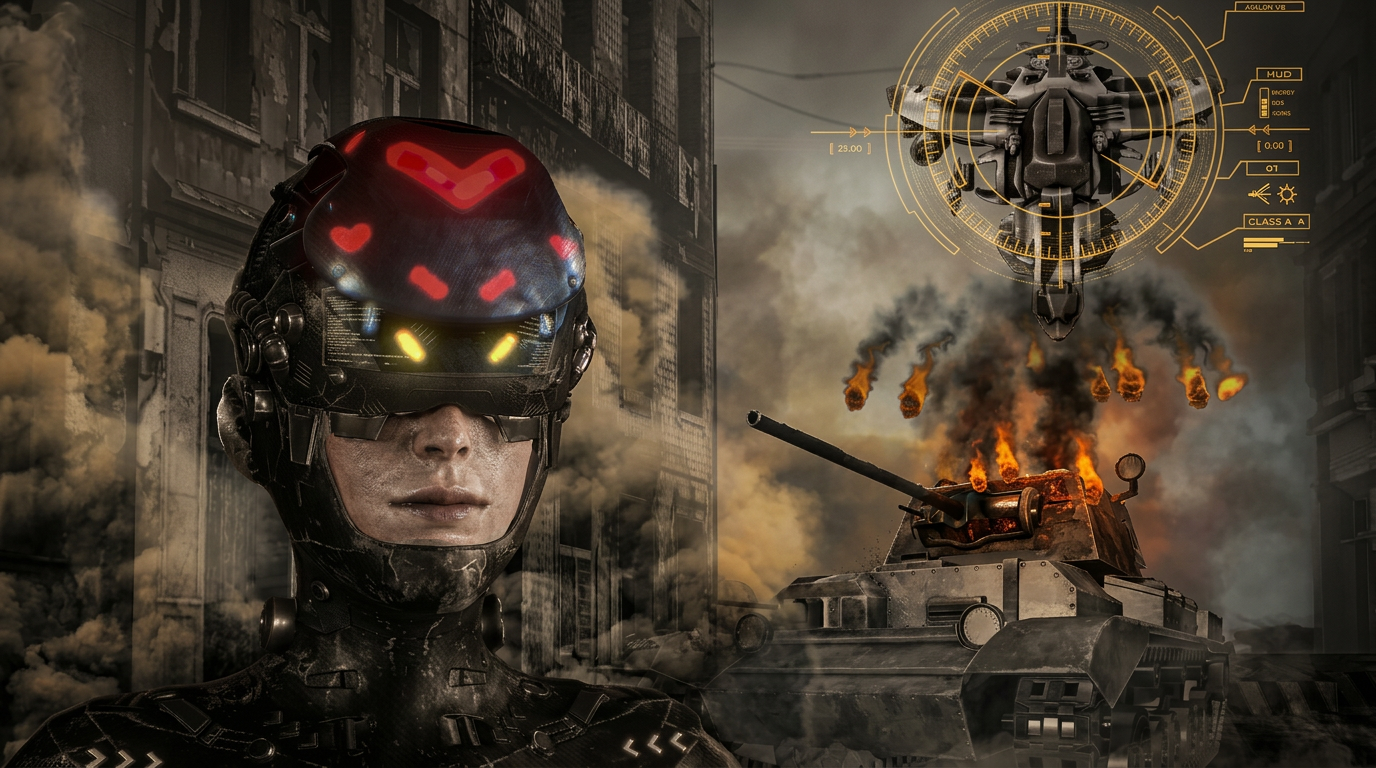
AvalonXR game concept, 2026.
A vertical slice of AvalonVR — a VR game concept originally pitched as part of an MA in Virtual Reality at UWE in 2020, adapted from Mamoru Oshii’s Avalon (2001). Two nested worlds. One player. The pitch was academic. The slice will be real.
AvalonXR game concept, 2026.
In 2020, AvalonVR was an academic pitch for the Oculus Quest Store — a fully realised concept including game design documentation, a fictional Wired article, and a launch party hosted inside AltspaceVR. The pitch was complete. The game was not.
AvalonXR takes the core premise and builds one playable vertical slice: a single complete section of the experience, demonstrating the full logic of the world. Not a demo. Not a proof of concept. A slice deep enough to prove the idea. Engine TBC — comparing Unity and Unreal before committing the pipeline.
The worldPlayers exist in two states simultaneously. In the base layer: an Eastern European city rendered in sepia — heavy, inert, looping. In the game layer: Avalon Online, an underground VR experience accessed through rented terminals. The player is both a citizen of the grey world and a freedom fighter inside the game.
The vertical slice contains both layers and the threshold between them. The moment of logging in — the terminal, the loading sequence, the shift from sepia to colour — is the core interaction. Everything the game is about happens at that boundary.
The sliceOne complete section: arrival in the grey city, navigation to a terminal, entry into Avalon Online, one mission inside the game layer. The visual grammar follows the film — sepia desaturation for the base world, full colour for Class Real. The transition between them is the experience.
The game is built in Unity for PCVR, with characters developed using Character Creator and animated in iClone.
OriginThe source material is Mamoru Oshii’s Avalon (2001) — a Japanese–Polish co-production Oshii described as his response to both The Matrix (1999) and Ghost in the Shell (1995). The film’s central argument: that a sufficiently inhabitable simulation, chosen consciously, is a rational answer to a genuinely hard life.
The themes from the original pitch carry forward: militainment, realism, and agency inside systems designed to remove it, layered inside a dual reality. The game doesn’t resolve these. It puts the player inside them.
The 2026 VisionIt is an artistic, narrative-heavy VR project that blends film theory with game design. It's a "passion project" moving from a paper-based academic idea into a physical, playable build.
→ Read the original pitch writeup
→ Read the film analysis: Avalon: Reality, Desaturated